What the May–June 2026 Cabinet Industry News Roundup Actually Tells Us

Learn what the May–June 2026 cabinet industry news roundup reveals about leadership, automation, finishes, and supply chains. Read the insights.
If you skim a trade roundup, it can look like a pile of unrelated announcements. A new CEO here. A stain launch there. A warehouse ribbon-cutting. An anniversary event. Easy to scroll past.
But when you read the May–June 2026 cabinet industry member news as a set, a clearer picture shows up. This is an industry investing in leadership, automation, finish technology, logistics, and supply chain reliability, while still talking about craftsmanship and legacy with a straight face. That mix matters.
For anyone involved in home renovation, kitchen remodeling, bathroom renovation, or even closet and storage solutions, these updates are more than internal business news. They hint at what may affect product availability, finish options, production speed, pricing pressure, and the kind of cabinetry homeowners will see over the next year.
First, a quick look at what was announced
The roundup included several types of news:
Angela Bouma of Crystal Cabinet Works in Minnesota was elected the association’s next president for a one-year term beginning June 1, 2026.
A member introduced a new cabinet stain called “Bourbon,” described as a warm, mid-tone brown finish.
Specified Components Company named Nathan Klomp as CEO, effective immediately.
Würth Louis and Company scheduled Open House and Demo Days for June 3–4, 2026, centered on advanced manufacturing solutions.
Marsh Cabinets marked its 120th anniversary with a weeklong “Legacy Week” celebration in High Point.
Häfele America appointed Olivier Vareille as president, effective March 9, 2026.
A sponsored commentary argued that global supply chains were never truly stable, and that reliability is now shaping sourcing decisions.
Hansen & Company Woodworks opened “HCo 2.0,” described as North America’s first fully automated frameless batch-one cabinet production line.
FinishMatch released V2 of its finish-detection tool, adding the ability to identify grain pattern, glaze, and distress level from a single photo.
Gemini Industries completed a new warehouse in El Reno and celebrated it with a ribbon-cutting on March 20.
That is a lot of movement for a short time window. And most of it points in the same direction.
Leadership changes are not just personnel news
Three items in the roundup focused on leadership: the election of Angela Bouma, the appointment of Nathan Klomp at SCC, and the appointment of Olivier Vareille at Häfele America.
That might sound routine, but leadership transitions often tell you what a company or an industry wants next. A trade association choosing a president from a company known for sustainability experience suggests that environmental performance is still part of the conversation, even when the daily headlines lean harder toward production speed and supply chain resilience.
At the company level, CEO and president appointments usually come at moments when firms want sharper execution, expansion, or a new operating focus. You do not announce those changes in isolation. You announce them because you expect them to shape direction.
For contractors, designers, and homeowners planning a custom kitchen cabinet project, these shifts may not change tomorrow’s order sheet. But they can influence what happens over the next 12 to 24 months: product line decisions, dealer support, manufacturing investments, and priorities around hardware, materials, and service.
The cabinet business has always had a practical streak. If leadership changes are appearing alongside automation launches and warehouse expansion, I read that as a sign that companies are trying to tighten operations, not just polish their org charts.
Finish trends are leaning warm again, and that matters in real projects
One of the simpler announcements in the roundup may also be one of the most useful: the introduction of a stain called “Bourbon,” described as a warm, timeless mid-tone brown finish for cabinet doors.
That short description says a lot.
For years, homeowners have bounced between painted finishes, pale woods, dramatic dark tones, and natural looks that try hard not to look “designed.” Now warm brown is clearly holding its ground. Mid-tone stains are appealing because they sit in a comfortable middle zone. They do not show every speck the way some dark finishes do, and they do not feel as stark as cooler gray-based tones often did.
In kitchen remodeling, a finish like this works across very different styles. It can read classic on a shaker kitchen cabinet, cleaner and more architectural on slab doors, or more tailored on a vanity in a bathroom renovation. It also plays well with materials people already know and request often, including quartz, marble, wood flooring, brushed metal hardware, and neutral countertop palettes.
That does not mean every project should chase warm brown. Trend-following can get silly fast. But if you are trying to design cabinetry that ages well visually, a warm mid-tone stain is one of the safer bets. It has enough character to feel intentional, but not so much that it traps the room in a single moment.
This is also where “luxury design” and “affordable quality” stop being opposites. A thoughtful stain choice can make a kitchen cabinet or vanity feel more expensive without forcing the entire room into premium material selections. Finish does a surprising amount of work.
Automation is moving from buzzword to real production strategy
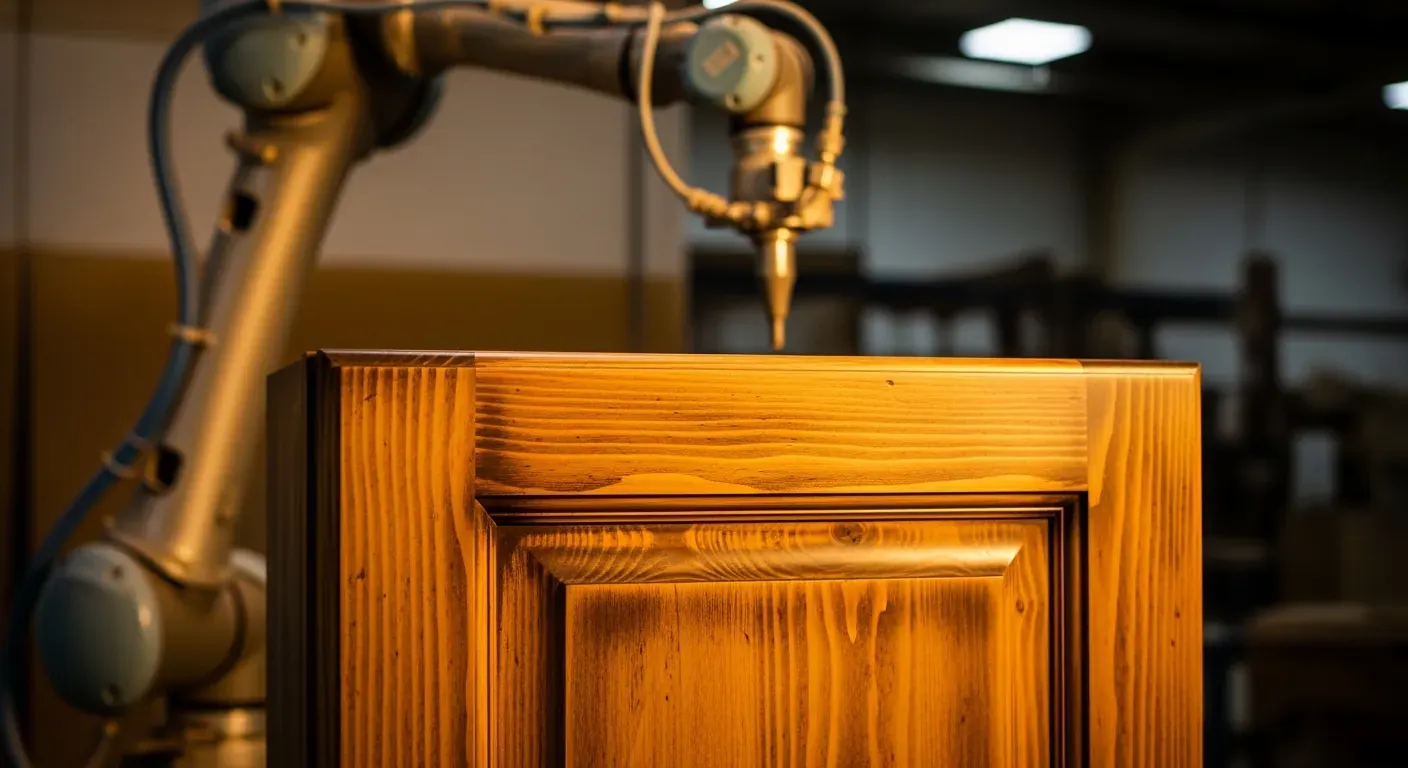
The most eye-catching manufacturing announcement in the roundup came from Hansen & Company Woodworks, which opened “HCo 2.0,” described as North America’s first fully automated frameless batch-one cabinet production line.
That deserves a plain-English translation.
“Frameless” usually refers to European-style cabinet construction, where the cabinet box does not have a face frame on the front. “Batch-one” production means making highly individualized products efficiently, often as if each order were its own mini production run. In other words, automation is being applied not just to standard boxes, but to customized cabinetry.
That is important because customization has traditionally been where complexity slows everything down. Every size change, finish change, drilling pattern, or accessory adjustment creates friction. A truly automated batch-one environment aims to reduce that friction without forcing every customer into a handful of standard options.
If that model works at scale, homeowners could eventually see shorter lead times, fewer production errors, and more precision in custom kitchen cabinet and storage programs. It may also affect closet and storage solutions, where customization is often essential rather than optional.
There is a catch, though. Automation does not magically fix design mistakes. It makes good information more powerful and bad information more expensive. If measurements are wrong or specifications are sloppy, a fast automated line can still produce the wrong thing very efficiently.
That is why the best result for consumers is not “more automation,” full stop. It is better coordination between design, specification, and manufacturing.
Demo events show where the market’s attention is
Würth Louis and Company’s June 3–4 Open House and Demo Days focused on advanced manufacturing solutions. Events like that are worth paying attention to because they reveal what suppliers think manufacturers want to see right now.
And right now, the appetite appears to be for production systems that make operations faster, leaner, and more consistent. Not glamorous. Useful.
That can sound distant from a homeowner’s concerns about door style, countertop material, or whether a marble backsplash is worth the maintenance. But behind every finished kitchen is a chain of machinery, software, logistics, and process control. When that chain improves, the visible result is often a better installation experience: fewer missing parts, cleaner fit, more predictable timing.
Trade events also act as idea exchanges. A manufacturer may attend to look at one machine and leave rethinking its finishing line, software integration, or material handling. News about demo days is really news about where companies are shopping for their next operational advantage.
Software is getting better at understanding finishes
FinishMatch V2 may sound niche, but I think it is one of the most interesting announcements in the roundup. The updated system can detect grain pattern, glaze, and distress level from a single photo.
If that works well in practice, it could save time in one of the messiest parts of cabinetry: finish identification and matching.
Anyone who has tried to match an existing kitchen cabinet, vanity, or built-in knows how deceptive finish can be. A photo taken in daylight looks different from one shot under warm LEDs. Grain can disappear or look stronger depending on angle. Distressing can read as random wear until you compare it closely. Then there is sheen, which causes its own headaches.
Computer vision will not eliminate the need for human judgment. It should not. But it can help narrow the field faster, especially in renovations where one part of the home is being updated while another part stays in place. That is common in phased home renovation projects, and very common when people want a new island, pantry wall, or bathroom vanity that works with nearby cabinetry.
This kind of software also fits a broader industry pattern: reducing variation where variation causes waste. Better finish detection can lower remakes, improve communication, and help shops move more confidently when customers bring in “something like this” as a reference.
Warehousing and logistics are finally getting the attention they deserve
Gemini Industries’ new warehouse in El Reno is not flashy news, but it may be some of the most consequential.
When a company expands distribution capacity, it is usually responding to one of two realities: current demand is stressing the system, or the company expects future demand to do so. Either way, warehousing is about reliability. Can products be stocked, moved, and delivered with fewer delays? Can inventory be managed more cleanly? Can regional service improve?
After the last several years of supply disruptions, a warehouse announcement lands differently than it might have before. It is not just a real estate update. It is a signal that businesses are trying to build more control into the middle of the chain, where delays often compound quietly before customers hear about them.
For cabinet projects, that can affect coatings, finishing materials, and the timing of production itself. If a finish supplier becomes more dependable, the impact may ripple out to shops and installers who never mention the warehouse by name.
That is the unglamorous truth of this industry. A good kitchen remodeling experience often depends on systems the homeowner never sees.
Supply chain commentary has changed tone, and honestly, that feels overdue
One sponsored commentary in the roundup argued that global supply chains did not suddenly become fragile. They were always fragile. The difference now is that more people are willing to admit it, and reliability has become a major sourcing factor.
I think that is basically right.
For a long time, low cost and acceptable speed could hide a lot of structural weakness. Then disruption made those weaknesses impossible to ignore. The lesson was not simply “buy local” or “global is bad.” The lesson was that resilience costs something, and many companies had underbought it.
In cabinetry, sourcing decisions affect hardware, panel products, finishing materials, and accessories. If reliability is moving up the list, buyers may accept slightly different supplier mixes, more redundancy, or more domestic and regional capacity where it makes sense.
For consumers, that may mean two things happening at once. Some products may become easier to get because companies are de-risking their supply chains. Others may become more expensive if resilience is built into pricing. That tradeoff is not fun, but it is real.
If you are planning a project with specific requirements, say a certain hinge program, specialty insert system, or unusual finish, it is wise to ask about lead times and substitutions early. Especially if your design depends on a narrow set of materials.
A 120-year anniversary still matters, and not just for nostalgia
Marsh Cabinets celebrated 120 years with “Legacy Week” in High Point, centered on craftsmanship, people, and industry partnerships.
Anniversary news can drift into sentimentality fast. But in manufacturing, longevity does tell you something. A company does not make it to 120 years by accident. It adapts, survives ugly market cycles, changes equipment, changes leadership, and still finds a way to keep producing.
That matters because the current cabinet market is not purely a technology story. Even with automation and computer vision improving, buyers still care about build quality, finish consistency, and how cabinetry feels in daily use. Drawers either glide well or they do not. Doors line up or they do not. A vanity either handles moisture well or it does not.
Craftsmanship is sometimes treated like a soft idea, almost decorative. It is not. It is what keeps a product usable after the marketing language fades away.
The interesting part of this roundup is that legacy and automation are not being presented as enemies. They are sitting side by side. That feels accurate to where the industry is now.
What homeowners and project planners should take from all this
If you are not in the cabinet trade, this roundup still gives you useful signals for your next project.
First, warm wood tones are staying relevant. If you are choosing cabinetry for a kitchen, bath, or storage project, mid-tone stains are worth a serious look. They pair easily with quartz, marble, painted surfaces, and many countertop finishes.
Second, manufacturing technology is getting better at handling customization. That is good news if your space is awkward, your storage needs are specific, or your project includes built-ins beyond the kitchen.
Third, finish matching is becoming more precise. For partial remodels, that matters a lot. You may have more options for blending new work with existing cabinetry rather than replacing everything.
Fourth, supply chain reliability is now a design issue, not just a purchasing issue. A beautiful plan is only useful if materials and components can actually arrive on time.
If I were advising someone starting a kitchen remodeling or bathroom renovation project today, I would ask a few direct questions early:
Which parts of this design depend on long-lead materials or specialty components?
If a finish match is needed, how will it be verified?
Is the cabinetry fully custom, semi-custom, or adapted from a standard line?
What parts of the timeline are most vulnerable to supply delays?
Those questions are not dramatic, but they can save a lot of frustration.
One small site change says something too
The roundup page itself was updated to make news easier to find, with older posts moved to an archive. That is a minor detail, but it reflects something healthy: industry organizations are treating information access as part of member value.
That matters because trade news is often scattered. When leadership changes, product introductions, technology launches, and infrastructure investments are easier to track in one place, patterns become easier to spot. And once you can see the pattern, the news becomes more useful.
The pattern here is pretty clear. Cabinetry is getting more precise, more automated, and more logistics-aware, while still leaning on the language of craftsmanship and long-term trust. For people buying, specifying, or building cabinets, that combination is probably the real story of 2026 so far.