What Recent Cabinet Industry News Means for Home Renovation Projects

Learn what cabinet industry news means for home renovation projects, from pricing to lead times, and plan your remodel with greater confidence.
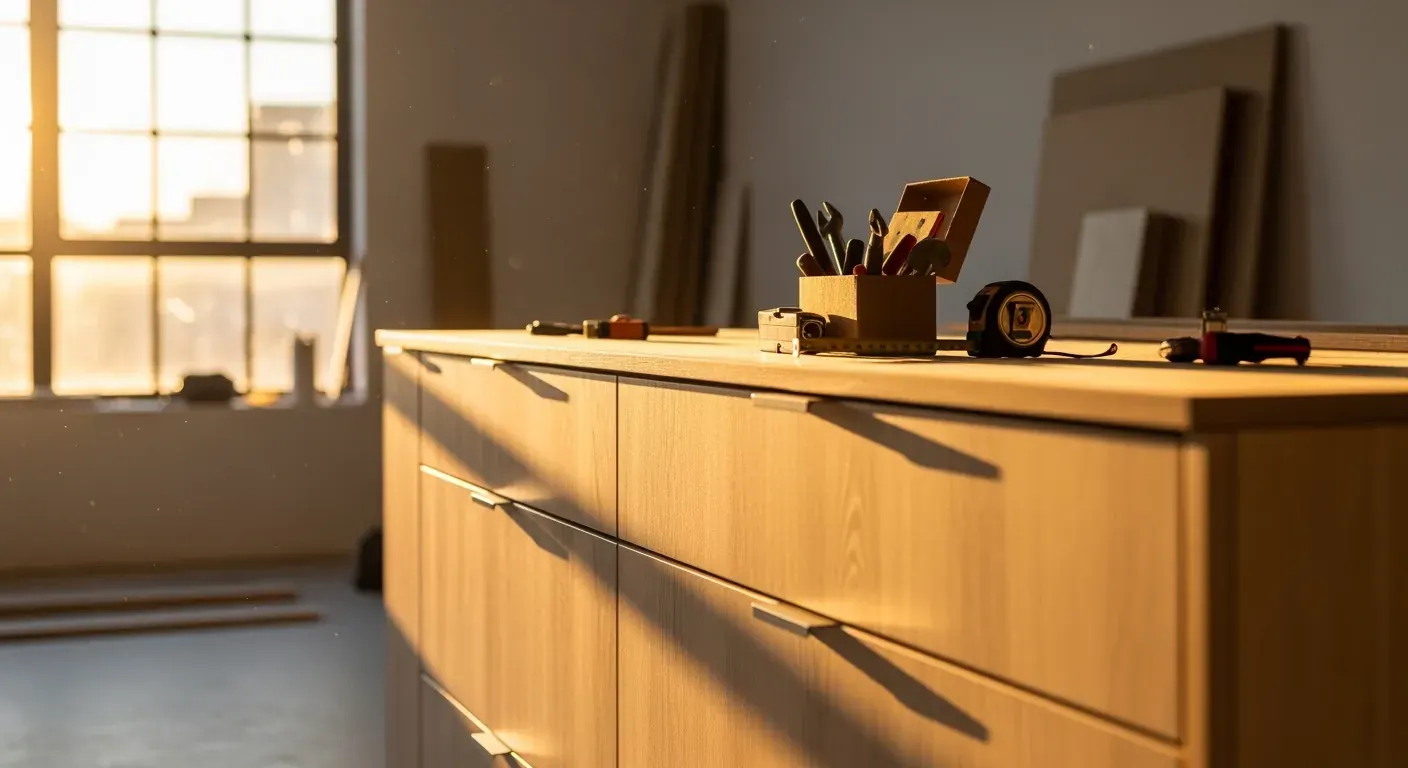
Cabinet industry news can feel a little distant if you are thinking about a kitchen remodeling job, a bathroom renovation, or better closet and storage solutions. Most headlines are about sales reports, plant awards, board appointments, or factory safety. Fair enough. That does not sound like the stuff of paint samples and quartz selections.
But it matters more than it seems.
Cabinetry sits in the middle of a renovation project. It affects layout, storage, appliance fit, countertop timing, plumbing locations, and often the whole budget mood. When cabinet sales soften, when custom shops hold up better than stock lines, when a plant changes hands, or when safety problems trigger fines, those developments eventually show up in pricing, lead times, product availability, and project risk.
Recent cabinet industry coverage gives a useful snapshot of where the business is right now. The picture is mixed. Sales are down in some segments. Custom work is holding up better. Manufacturers are still investing in leadership and continuity. Safety enforcement remains very real. And there is fresh evidence that cabinets are not just products, they are part of how communities rebuild after disruption.
The market is cooler, but not flat
One of the clearest recent signals came from the Kitchen Cabinet Manufacturers Association trend report for April. Overall cabinet sales were down compared with both the same month last year and the previous month. That is a straightforward slowdown.
Still, the details matter. Custom cabinets were the only segment that grew in both comparisons. Semi-custom declined year over year and month over month. Stock cabinets were mixed.
I think this is one of those moments where broad market numbers hide what buyers are actually doing. When budgets get tighter or people feel uncertain, they do not all respond the same way. Some postpone projects entirely. Some trade down. Some become much more selective and decide that if they are going to spend at all, they want a custom kitchen cabinet plan that solves real storage problems instead of a basic layout they will regret in two years.
That split helps explain why custom can perform better even in a softer market.
A stock kitchen cabinet line works well when dimensions are standard and the room is forgiving. Real homes are not always forgiving. Older kitchens can have out-of-square walls, weird soffits, awkward plumbing, and limited circulation space. Bathroom renovation work has its own version of that problem. Vanities need to fit doors, drawers, outlets, and sometimes existing tile layouts that nobody wants to touch. In those situations, custom work is less about status and more about making the room function.
That does not mean every home renovation needs custom everything. It does mean the custom segment tends to keep demand when homeowners want precise results or have specific design goals.
Big sales numbers do not erase caution
Another recent report, the FDMC 300, put the cabinet and closet maker segment at $15.6 billion in sales, or 21.8% of the total sales tracked in that ranking. That is a large share. Cabinets and related storage products are still a major slice of the wood products business.
At the same time, the mood described around those numbers was cautious.
That combination makes sense. A sector can still be large and important while buyers become slower to commit. Contractors see this all the time. The phone rings, people ask for estimates, mood boards get built, samples go home, and then a project pauses because financing changed or the homeowner decided to delay a countertop upgrade until next year.
In practical terms, a cautious market often creates a few patterns:
Projects go through more revisions before approval.
Buyers compare materials more closely, especially when choosing between painted finishes, wood species, hardware upgrades, and premium surfaces like quartz or marble.
People ask harder questions about lead times, deposits, and installation sequencing.
None of that is bad. If anything, it pushes the process toward better planning. The hard part is that cabinets touch so many parts of the renovation that one delay can ripple. A kitchen cabinet order affects when countertops can be templated. Countertop timing affects when plumbing fixtures go in. Vanity installation affects mirror, lighting, and tile punch lists. The fewer assumptions in the early phase, the better.
Why custom is performing better than many people expect
The custom category’s recent strength deserves more attention than a passing mention in a sales report.
For years, people have talked about custom cabinetry as if it belongs only to luxury design. That is too narrow. Yes, some custom work is high-end in the full, unapologetic sense: inset doors, furniture-grade finishes, hidden appliance panels, specialty organizers, and carefully matched wood grain. But custom also solves ordinary problems that stock systems handle poorly.
Think about a narrow galley kitchen where every inch matters. Or a mudroom that needs shoe storage, charging space, and room for sports gear. Or a vanity wall where the homeowner wants drawers instead of dead space because bending into a dark cabinet has gotten old. These are not exotic requests. They are everyday use cases.
That may be why custom holds up when the market gets uneven. People are not always chasing more. Often they are chasing fewer annoyances.
There is also a growing overlap between kitchen remodeling and whole-home storage planning. Buyers no longer think only in terms of upper and lower kitchen cabinets. They think about pantry walls, laundry storage, built-ins, media units, office nooks, and closet and storage solutions that make a house easier to live in. Once a project moves in that direction, custom or highly tailored semi-custom work becomes more attractive.
And then there is the simple truth that “affordable quality” means different things to different households. For some, it means the lowest upfront number. For others, it means paying more once to avoid replacement, filler panels everywhere, or wasted space. Neither definition is irrational. They just lead to different cabinet choices.
Manufacturing news points to continuity, not just churn
Recent company news in the cabinet sector had a little bit of everything: a plant award in Pennsylvania, a long-running family manufacturer marking 120 years in North Carolina, a newly formed group acquiring operating assets from a former Lockport cabinetry facility, and a trade association board appointment.
On the surface, these stories are unrelated. Put together, they say something useful about the business.
First, manufacturing continuity still matters a lot. When a facility changes hands but operating assets are acquired for continued use, that suggests there is still value in the equipment, the workflow, and often the local labor knowledge. Cabinet manufacturing is not just about machines. It is also about process discipline, finishing skill, and the ability to move from drawing to production without constant error.
Second, leadership matters more than people outside the industry sometimes realize. The Sayre, Pennsylvania plant recognized as Plant of the Year also drew attention to its plant manager, noted as the first and only female plant manager at that facility, with 25 years of tenure. I like that detail because it tells a more honest story about manufacturing excellence. Plants do not run well because of slogans. They run well because experienced people keep quality, staffing, maintenance, and output from drifting off course.
Third, long anniversaries are not just sentimental news items. A 120-year milestone says a company has survived recessions, style changes, material shortages, and generations of buyer preferences. That does not guarantee perfection, obviously. But it does suggest some staying power in a business where operations can get complicated fast.
For homeowners and builders, this type of news is a reminder that a kitchen cabinet order is backed by an organization, not just a door sample. Stability, ownership changes, leadership depth, and shop culture all affect what ends up in your house.
Safety news is easy to ignore until it is not
One of the more sobering recent reports involved a cabinet manufacturer in Kelowna, British Columbia that was fined more than $69,000 for repeated storage rack deficiencies. Inspectors found damaged and twisted rack uprights, along with missing bolts and anchors. The racks were not capable of safely supporting stored items.
This kind of story can seem like an internal factory issue with no connection to a home renovation project. I would argue the opposite.
Safe manufacturing is part of quality manufacturing. A shop that neglects storage rack integrity may also have weak maintenance habits, poor material handling, or inconsistent workflow controls. Those are not separate worlds. They tend to travel together.
No homeowner needs to become a warehouse inspector. But this is a good reminder to look beyond finish samples and price sheets when choosing cabinetry. Ask basic questions. How long has the company been operating? How do they handle quality control? What happens if something arrives damaged? Who is responsible for field measurements? What is the process if a vanity top is templated before the cabinet install is truly complete?
A reliable process is not glamorous. It just saves people from miserable weeks.
Safety news also speaks to labor conditions. Cabinet making involves sheet goods, heavy materials, finishing chemicals, cutting equipment, forklifts, and racking systems. Poor safety practices put workers at risk first. That should matter on its own. It also affects the buyer because unsafe shops are more vulnerable to disruptions, inspections, and operational instability.
Homeowners need to pay attention to closure risk
Another recent industry item covered a relief program for homeowners affected by cabinet manufacturer closures. The structure is pretty specific: participating dealers can provide credit equal to the amount previously paid as a 10% deposit, up to $3,000, and the credit is valid for 45 days after a qualifying closure. It applies only to U.S.-based manufacturers and assemblers, not importers.
That is a helpful program, but it also reveals a hard truth. Manufacturer closures can leave buyers stranded mid-project.
This is where renovation planning gets less fun and more adult. Before placing a cabinet order, especially a large kitchen remodeling order, it is worth asking a few pointed questions:
Who is actually manufacturing the cabinetry?
What part of the payment is deposit versus progress billing?
What protection exists if the manufacturer stops operating before delivery?
Is the dealer part of any relief or replacement program?
Are long-lead components, such as special finishes or organizer inserts, coming from separate suppliers?
You do not need to interrogate everyone like a fraud investigator. Still, clear answers matter. A kitchen without cabinets is annoying. A bathroom renovation with a missing vanity becomes a scheduling mess. A delayed cabinet package can also stall flooring protection, countertop fabrication, appliance install, and final inspections.
This is one place where the cheapest quote can get expensive in a hurry. Price matters. So does the ability to finish the job.
Resilience stories tell a more human truth about manufacturing
A recent magazine story looked back at the catastrophic south Louisiana flood of August 2016, when more than 20 inches of rain fell in 48 hours and communities faced severe damage, evacuations, and long rebuilding efforts. A regional manufacturer, Gator Millworks, was part of that recovery story.
I think these stories are worth reading because they break the usual frame. We often talk about cabinet companies as if they only produce products. In reality, many are employers, training grounds, problem-solvers, and local anchors. When disaster hits, the firms with equipment, fabrication skill, trucks, and relationships often become part of how a place gets back on its feet.
That matters beyond floods. Storms, fires, supply chain disruptions, and abrupt closures all test whether a business can adapt. Resilience is not a soft concept here. It shows up in whether people can source material, rework schedules, communicate honestly, and keep jobs moving.
For consumers, that can sound abstract until it becomes personal. If you are halfway through a home renovation and a supplier runs into trouble, you suddenly care a lot about whether the company and dealer know how to recover.
The multifamily angle is worth watching
An opinion piece from a KCMA-certified manufacturer focused on American-made, built-to-spec production for multifamily projects. That may sound like a niche topic for developers, but it touches the residential market too.
When domestic cabinet manufacturers re-enter or expand in multifamily work, it can shift production capacity, material demand, and factory scheduling. Large built-to-spec jobs can absorb significant shop time. Depending on the manufacturer, that may either improve efficiency through steady volume or tighten lead times for smaller residential orders.
There is another piece here. Multifamily projects often push manufacturers toward repeatable quality, durable finishes, and predictable installation standards. Those disciplines can benefit residential buyers too. A company that can manage scale without losing control may be better prepared to deliver a consistent kitchen cabinet or vanity program for individual homes.
The caution is that homeowners should not assume every shop is equally suited for both worlds. High-volume multifamily production and deeply customized residential work require overlapping but different muscles.
What this means if you are planning a renovation
If I had to boil all this down for someone choosing cabinetry right now, I would keep it simple.
First, expect more variation between product categories than the phrase “cabinet market” suggests. Stock, semi-custom, and custom are not moving in lockstep. That affects pricing, availability, and the kind of flexibility you can expect during design.
Second, treat cabinets as the operating system of the room, not a decorative afterthought. Your countertop choice, whether quartz, marble, or another surface, depends on stable cabinet dimensions. Your appliances need accurate openings. Your vanity location affects plumbing and mirror alignment. Once cabinetry is wrong, a lot of downstream work gets weird.
Third, ask stability questions early. Who makes the product? How long have they been doing it? What happens if there is a delay, defect, or closure? Recent industry news makes clear that continuity is not something to assume.
Fourth, do not separate quality from safety and operations. A tidy showroom does not tell you how a manufacturer stores material, trains staff, or handles production errors.
Fifth, be honest about what kind of project you have. If your room is simple, a stock or semi-custom kitchen cabinet line may be the smart call. If your home has odd dimensions, heavy storage demands, or a specific luxury design goal, custom cabinetry may actually be the more rational route.
The bigger picture
The cabinet business is in an interesting spot. Sales are softer in places. Custom work is proving more resilient than many would have guessed. Manufacturers are still getting recognized, changing hands, celebrating long histories, and dealing with the everyday realities of safety and oversight. Relief programs exist because closures have real consequences. Rebuilding stories remind us that local manufacturing can matter far beyond the shop floor.
For anyone in home renovation, that mix is worth paying attention to.
Cabinets are not just boxes with doors. They shape how a kitchen works, how a bathroom feels, how storage supports daily life, and how smoothly a project moves from design to installation. Industry news does not tell you which finish to choose or whether your island needs seating. It does tell you something just as important: what kind of market and manufacturing system your project depends on.