What an Associate Spotlight Page Can Teach You About the Kitchen Cabinet Industry

Learn what an associate spotlight page reveals about the kitchen cabinet industry and cabinetry quality. Explore key insights with Spruce Wood Ltd.
At first glance, an associate spotlight page looks simple. A logo, a short blurb, maybe a photo, then a link if you want more. Easy to skim, easy to forget.
I think that undersells what a page like this actually does.
If you read it carefully, it becomes a compact map of the kitchen cabinet industry. You can see who handles sanding, who helps with finish selection, who builds organizers, who supplies hardware, who supports CAD and CNC workflows, and who makes machinery that most homeowners will never hear about, even though it shapes the final result in a very real way.
That matters because a finished kitchen cabinet is never just a box with a door. It is the product of design choices, materials, finishing methods, hardware quality, adhesive systems, manufacturing precision, and storage planning. The same is true in Home Renovation more broadly. The behind-the-scenes network affects how a project looks, how long it lasts, how it feels to use every day, and how much it costs to build.
So even though a spotlight directory is short on detail, it can still teach you a lot. It shows where value is created in Cabinetry, where quality can drift, and where good project decisions usually start.
Why a directory-style spotlight page matters
A directory page is not a case study and it is not a technical manual. It is more like a labeled cross-section of an industry.
In the cabinet world, that is useful because many people only see the final installation. They see painted doors, a Quartz island, a Marble backsplash, maybe a new Vanity in the bath, and assume the story is mostly about style. Style matters, obviously. But the practical side matters just as much, sometimes more.
Take a typical Kitchen Remodeling project. You might focus on door profiles, color, lighting, and the Countertop. Behind that, somebody has to decide how surfaces will be prepped, how finishes will be matched, what hardware will hold up, whether the corner cabinet will actually work, how adhesives will perform near heat and moisture, and how digital drawings will turn into cut parts without expensive mistakes.
A spotlight page makes that hidden chain visible.
The entries in this set do that especially well because they cover several layers of the cabinet supply chain instead of clustering around one niche. You see product companies, service partners, machinery makers, and component manufacturers in the same place. That gives a more honest picture of how a Custom Kitchen Cabinet project comes together.
The supply chain roles hiding inside the spotlights
The featured companies fall into a few clear categories. Once you group them, the page starts to read less like a list and more like a workflow.
Surface preparation and finishing
Some of the strongest clues on the page come from the sanding and finishing side.
SurfPrep is described as bringing nearly 50 years of experience in sanding and surface preparation. That tells you something important right away. Surface prep is not a minor step. It is one of the steps that decides whether a finish looks clean, feels smooth, and ages well. You can have expensive material and still get a disappointing result if the prep work is sloppy.
KLINGSPOR Abrasives sits in a similar zone, with abrasive products for industrial use and a stated emphasis on in-house manufacturing in Hickory, North Carolina. That detail about making many products in-house matters because it points to control over production, quality checks, and shipping. In manufacturing, process control is not glamorous, but it tends to show up in consistency.
Uneeda also speaks to the same concern from another angle. Its focus is helping customers get strong sanding results while lowering sanding costs. That is a very practical tension in production. Shops want speed and lower consumable costs, but they cannot afford visible defects on finished Cabinetry. The best sanding systems are usually the ones nobody notices, because the finish simply looks right.
Then there is JDC Supply, a family-owned stain manufacturer and industrial supplies distributor. Stain and finishing support can make or break visual consistency, especially when wood grain, species variation, and jobsite lighting all get involved. Anyone who has seen one door come out slightly warmer or darker than the rest knows this is not a fussy detail. It is the detail clients stare at.
FinishMatch rounds out this group in an interesting way. Instead of making abrasives or stains, it simplifies finish selection for manufacturers, customers, and dealers. That sounds almost administrative, but it solves a real problem. Finish selection is often harder than people expect. A color that looks perfect on a sample chip may shift next to a bright Countertop, warm flooring, or a slab of Marble with strong movement. If a tool makes finish decisions clearer and faster, it reduces friction for everyone.
Storage, accessories, and hardware
A second cluster on the page focuses on function after installation, which is where real life begins.
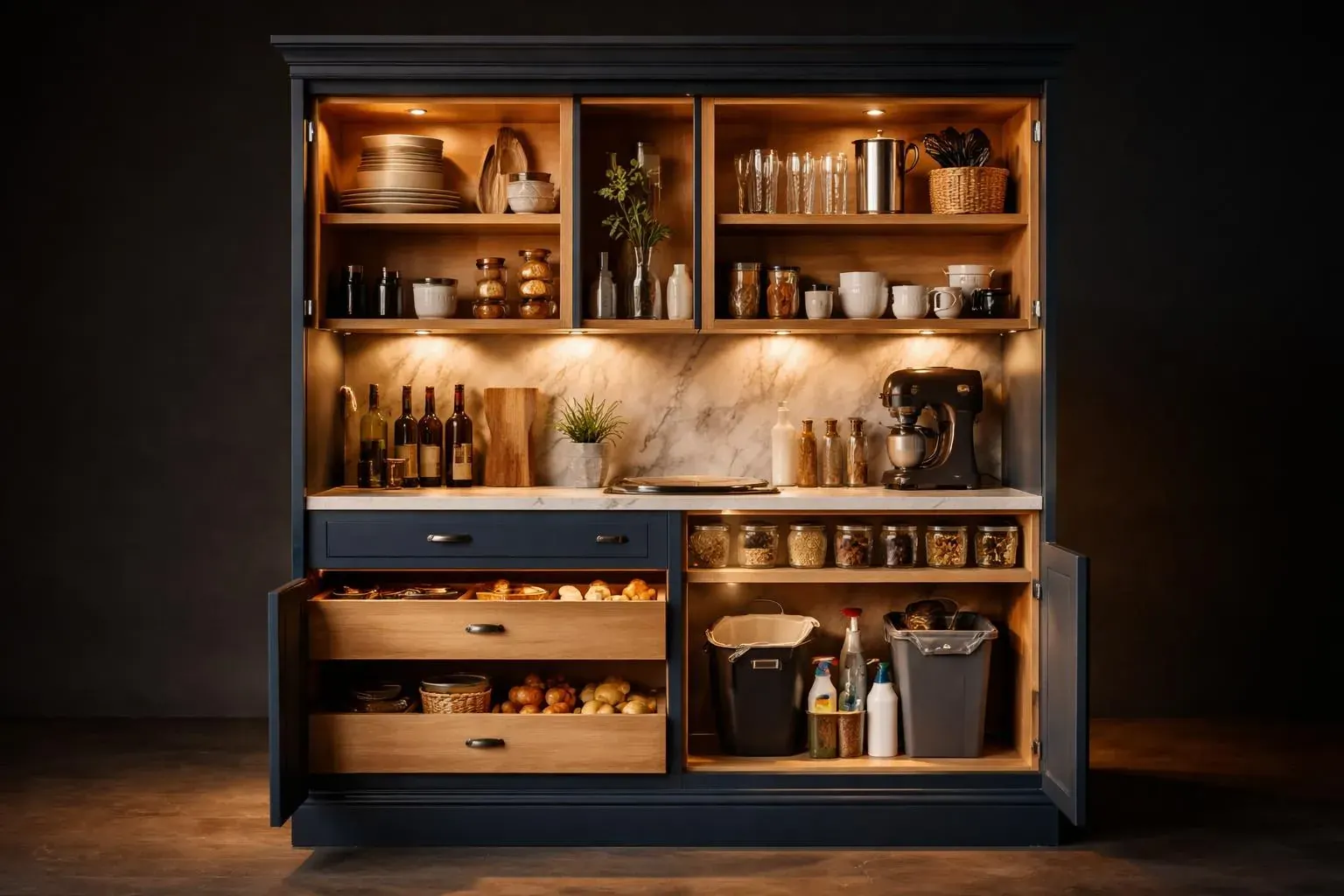
Century Components designs and manufactures premium cabinet organizers and accessories, including waste pullouts, drawer organizers, and corner solutions. These are the parts that determine whether a kitchen works gracefully or just photographs well. I have mixed feelings about the term “premium” because it can mean anything in marketing. But when it comes to organizers, there really is a difference between hardware that feels deliberate and hardware that feels like an afterthought.
Good storage planning has effects beyond the kitchen too. Closet and Storage Solutions borrow heavily from the same logic. Pullouts, dividers, tray storage, hidden bins, and access to awkward corners all matter in laundry rooms, mudrooms, pantries, and bath spaces.
SiYi America sits nearby in the chain as a hardware company focused on North American kitchens and closets. Hardware often gets discussed late in a project, which is a mistake. It influences door movement, drawer feel, long-term durability, and user satisfaction more than people admit. If cabinet doors rub, drawers sag, or soft-close action feels inconsistent, the room never quite feels finished, no matter how nice the material palette is.
For homeowners planning a Bathroom Renovation, this is especially relevant. A Vanity is a smaller cabinet package than a full kitchen, but users touch it constantly. Hinges, pulls, drawer organizers, and interior access matter every single day.
Machinery, adhesive systems, and production equipment
This category is less visible to the average client, but it explains a lot about manufacturing quality.
Black Bros. Co. produces laminating and roll coating machinery and has a reputation as a trusted technology provider in the kitchen cabinet industry worldwide. That is a reminder that finished panels and coated surfaces depend on equipment, not just craftsmanship in the romantic sense. Shops need machines that apply materials consistently. If roll coating is off, or laminating pressure is uneven, the downstream problems show up later.
Hot Melt Technologies focuses on adhesive systems that can be modified after purchase as production needs change. I like this detail because it points to flexibility instead of lock-in. Production lines change. Materials change. Output changes. A system that can adapt may help a manufacturer avoid a full replacement when demand or product mix shifts.
In practical terms, adhesive systems matter in more places than people think. Edgebanding, panel work, laminates, wraps, and assembly operations all rely on dependable bonding. In a humid kitchen or bath, small failures become visible fast. When you see peeling edges or lifted surfaces, you are often looking at a manufacturing choice that seemed invisible at the start.
Design support and component supply
The final cluster on the page deals with design information and component creation.
MokshCAD specializes in estimation, take-off work, CAD drafting, CNC programming, and data processing. That puts it near the front end of production, where decisions are translated into shop-ready instructions. This role deserves more attention than it gets. A project can look beautifully designed on paper and still fail in execution if the data pipeline is messy.
For shops handling Custom Kitchen Cabinet work, outsourced drafting and CNC support can help with capacity, speed, and error reduction. That does not remove the need for oversight. It just shows that modern Cabinetry depends on digital coordination as much as woodworking.
Art For Everyday Inc. manufactures solid wood components in North America. This points to the component side of the supply chain, where doors, moldings, face frames, and wood parts can be sourced rather than made entirely in-house. That is common, and there is nothing lesser about it. The real question is whether the components fit the quality level, lead time, and visual goals of the project.
Stanisci Design and Manufacturing LLC adds another specialized angle with American-made premium wood range hoods produced in Oxford, Michigan. Range hoods often sit at the intersection of function and Luxury Design. They can act like a visual anchor in the room, especially in traditional or transitional kitchens where wood detailing matters. But they also have to coordinate with ventilation needs, clearances, and finish consistency. A statement piece that does not integrate well is just expensive frustration.
What homeowners and designers can learn from these profiles
Even though these entries are written for an industry audience, they are useful for anyone involved in renovation planning.
The big lesson is that quality is distributed. It does not live in one product or one decision.
A beautiful Kitchen Cabinet line can be weakened by poor hardware. Smart organizers can be let down by a bad finish. Strong design can get bogged down by weak drafting or messy data transfer. A stunning kitchen with Quartz counters can still feel annoying if the corner storage is clumsy and the waste pullout jams.
That is why spotlight pages are more educational than they first appear. They show where expertise sits in the process.
For people planning Home Renovation work, this can sharpen the questions you ask. Instead of only asking what door style or what color, you can ask how finishes are selected, what organizer options exist, where the hardware comes from, whether wood components are sourced or made in-house, and how design files are handled before production.
The same mindset carries into Bathroom Renovation. A bath project may involve fewer cabinets, but the stakes are similar. Moisture, finish durability, interior organization, and hardware quality still matter. Even material choices around a Vanity, whether paired with Quartz, Marble, or another Countertop surface, need coordination with the cabinet finish and storage design.
And if you are comparing budget options with more elevated ones, this is where the phrase Affordable Quality becomes real instead of vague. It is not about chasing the cheapest line item. It is about knowing which parts of the system actually affect daily use and long-term satisfaction.
How to read a spotlight entry without overreading it
A spotlight page is helpful, but it has limits. Short blurbs are compressed by design. They summarize strengths, not weaknesses, and they rarely include technical depth.
That means you should treat each profile as a starting point, not a verdict.
When you read a directory entry, five questions help keep you grounded:
What exact problem does this company solve?
Where in the production or design process does that problem appear?
What evidence of quality is actually stated, and what is just positioning language?
Would this matter to my kind of project, or only to high-volume manufacturers?
What follow-up details would I need before making a decision?
Those questions are especially important here because the digest itself notes what is missing. There are no detailed specs, no pricing, no certifications, no distribution information, and no case studies. That is normal for a spotlight page, but it changes how you should use it.
For example, “nearly 50 years of experience” tells you SurfPrep has longevity, but it does not tell you which sanding systems fit your workflow. “In-house manufacturing” tells you KLINGSPOR controls more of its process, but it does not tell you lead times or product compatibility. “Adaptable post-purchase systems” tells you Hot Melt Technologies values flexibility, but it does not tell you training needs or maintenance demands.
That does not make the spotlights weak. It just means they are introductions.
The bigger lesson behind a simple page
What I like about this kind of directory is that it quietly corrects a common misconception. People often talk about Cabinetry as if it is a single category. It is not. It is a network of materials, equipment, design intelligence, organization products, coatings, hardware, and specialized manufacturing support.
Once you see that, renovation decisions get clearer.
You understand why one Kitchen Cabinet quote differs from another. You see why two rooms with similar colors can perform very differently. You realize why a good designer asks so many practical questions. And you stop treating accessories, finish prep, and hardware as side notes.
That is true whether the project aims for clean modern minimalism, a more classic Luxury Design look, or a careful balance between style and Affordable Quality. It is true in kitchens, baths, and storage spaces. It is even true when the attention seems focused elsewhere, on the Marble island, the Quartz Countertop, or the statement hood. The visible design only works well when the hidden system holds together.
A spotlight page will not tell you everything. It is too short for that. But it can teach you where to look next, and that is often the most useful first step.