Apron-Front vs. Undermount Sinks: How to Plan Cabinets, Countertops, and Cleanup

Compare apron-front vs. undermount sinks for cabinet fit, countertop installation, cleanup, and cost. Plan your kitchen sink with confidence before fabrication.
A kitchen sink can look like a finishing detail until it changes the cabinet beneath it, the countertop cutout, and the installation schedule. By the time you are comparing sink styles, those decisions may already be taking shape. That makes sink selection more urgent than it first appears.
For many homeowners, the choice comes down to an apron-front sink with a visible face or an undermount sink tucked beneath the countertop. One draws attention. The other keeps the counter visually uninterrupted. Both can work well in a busy family kitchen, but the differences go well beyond appearance.
There is also an important distinction: apron-front and undermount describe different aspects of a sink. An apron-front sink can be installed as an undermount. Understanding that overlap will help you ask better questions, compare estimates, and avoid expensive revisions during kitchen remodeling.
First, Separate Sink Style From Mounting Method
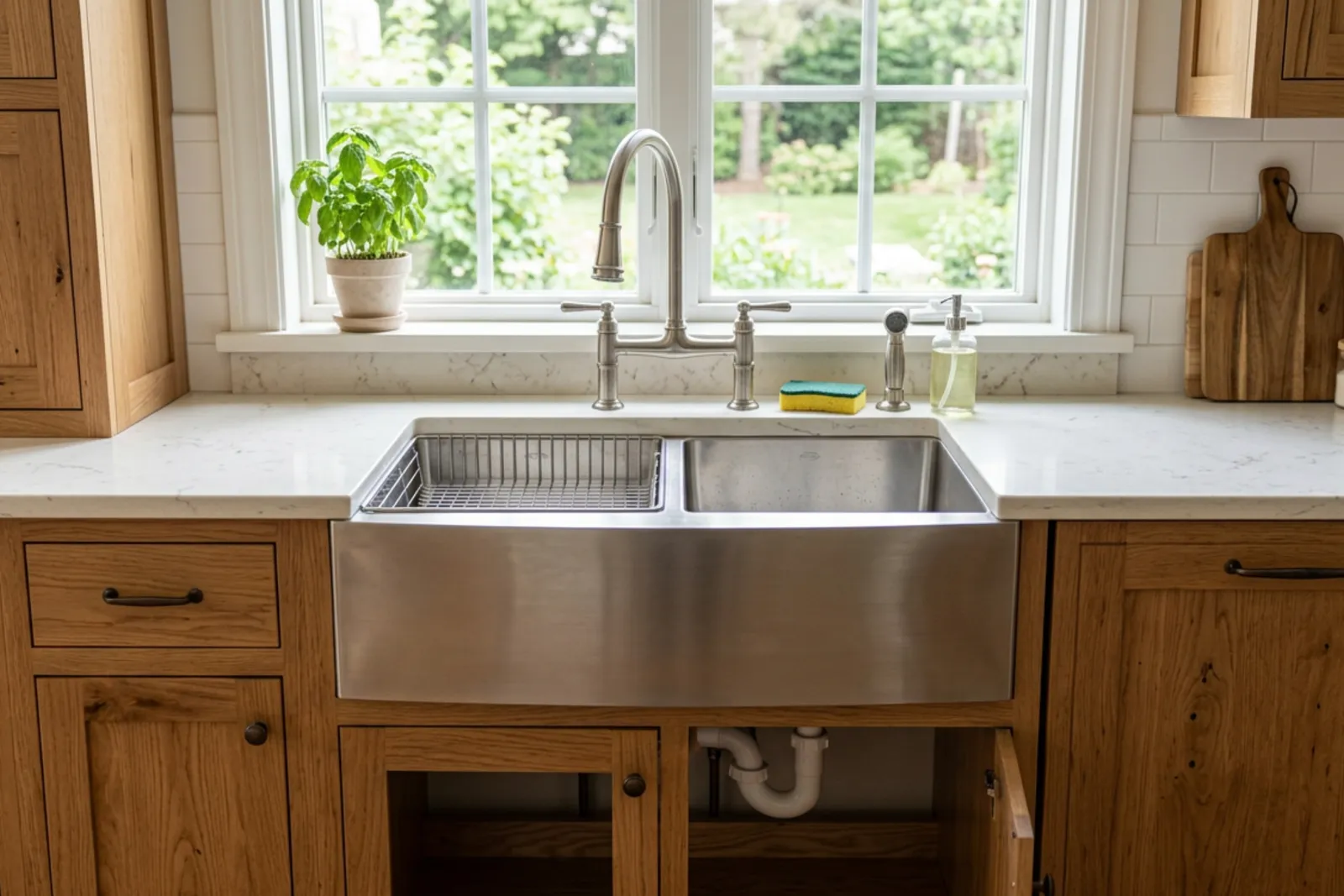
An apron-front sink, often called a farmhouse sink, has an exposed front that replaces part of the cabinet face. It may be made of fireclay, stainless steel, cast iron, or another material. The apron is its defining visual element, not a specific installation method.
An undermount sink attaches beneath the countertop rather than resting on top of it. There is no raised sink rim on the work surface, so crumbs and water can be swept toward the bowl without catching on a top-mounted lip.
Some apron-front sinks are undermounted. Others sit flush with the countertop or have a different edge configuration. For a useful comparison, think of the options as:
An apron-front sink with an exposed face and a cabinet designed or modified to accommodate it.
A conventional undermount sink with its front concealed behind the countertop edge and cabinet face.
This distinction matters when you look at product descriptions. A label such as “farmhouse” does not tell you everything about the mounting requirements, countertop cutout, or support system. The specific model’s installation instructions do.
Why the Sink Decision Should Come Before Cabinet Approval
A sink affects much more than the opening in the countertop. Its width, depth, drain location, and weight influence the entire sink base.
With a conventional undermount sink, the cabinet generally retains its front rail and doors below it. Even then, the sink must fit within the usable interior space. A nominal cabinet width is not the same as its clear opening, and bowls, mounting hardware, and support components all need room.
An apron-front model changes the cabinet face itself. The apron may require a shaped opening, shorter doors, or a purpose-built sink base. Some retrofit models are designed for certain existing cabinets, but compatibility must be checked carefully. Cutting an ordinary cabinet to fit an apron is not automatically a workable solution.
What a custom sink cabinet needs to accommodate
A custom kitchen cabinet can be built around the selected sink rather than adapted afterward. That allows the cabinetmaker to account for the apron profile, door clearances, structural support, and plumbing access before fabrication.
Heavy sinks may need a support frame, rails, or another manufacturer-approved system within the cabinet. The countertop and adhesive joint should not be assumed to carry the full load. The support must account for the sink in use, including water and dishes.
Plumbing also competes with storage. A deep bowl, garbage disposal, drain assembly, water filter, and pull-out waste bins can quickly occupy the same space. A cabinet drawing that looks generous without these components may be frustrating once everything is installed.
Ask to see the sink base with the actual equipment shown. It is much easier to relocate a pull-out on a drawing than after the cabinetry arrives.
Countertop Choice Changes the Installation Details
The sink and countertop should be selected together. Different materials have different requirements for cutouts, edge finishing, support, and exposure to moisture.
Quartz and natural stone
Quartz countertops and many natural stone surfaces are commonly paired with undermount sinks. Their exposed cutout edges can be finished, which makes a rim-free installation practical.
That does not make every cutout interchangeable. The fabricator needs the exact sink model and the intended mounting position. Depending on the product and shop procedures, they may require the physical sink before fabrication.
The visible relationship between the countertop edge and the bowl is called the reveal. A positive reveal exposes a narrow ledge of sink material. A negative reveal lets the countertop project slightly over the bowl. A flush reveal brings the two edges into alignment.
Each has cleaning trade-offs. An exposed ledge can collect residue, while an overhang can hide buildup beneath the edge. A well-executed flush reveal can be straightforward to wipe, but it demands accurate fabrication. Follow the sink manufacturer’s guidance and review the detail with the fabricator.
Marble, laminate, and other surfaces
Marble can work beautifully around a sink, but it requires realistic expectations. Acidic foods and cleaners can etch it, and some spills can stain it. Sealing helps with stain resistance; it does not prevent acid etching.
Standard laminate countertops generally are not suitable for a conventional undermount installation because exposed substrate is vulnerable to water. Specialized compatible systems exist, so the countertop manufacturer’s approval matters.
Solid-surface materials may allow an integrated sink with a smooth transition between the counter and bowl. That is different from a typical undermount sink, which still has a joint. “Seamless-looking” is often a more accurate description than “seamless.”
Installation Complexity: Where the Extra Work Happens
A conventional undermount sink often has fewer cabinet-face modifications than an apron-front model. It still needs careful installation.
The bowl must be positioned correctly, supported appropriately, and sealed at the countertop joint. Mounting hardware must suit the countertop material. Plumbing connections should remain accessible, and the installation should not interfere with drawers, doors, or nearby appliances.
An apron-front installation adds another set of measurements. The installer must establish how far the apron projects, how it meets adjacent cabinet faces, and where the bowl sits relative to the counter. Small alignment errors can be conspicuous because the sink is a focal point.
Some fireclay sinks have dimensional variation from manufacturing. That is one reason an actual sink may be needed before final cabinet fitting or countertop fabrication rather than relying solely on a published drawing.
During a home renovation, clarify who is responsible for each part of the installation. The cabinetmaker, countertop fabricator, and plumber may all touch the same area. Local contractors should agree on the sequence and support requirements before work begins, especially when existing plumbing or cabinetry will remain.
Which Sink Is Easier to Keep Clean?
For countertop cleanup, the mounting detail matters more than the presence of an apron.
Both an undermounted apron-front sink and a conventional undermount sink allow you to sweep crumbs directly into the bowl. Neither has the raised perimeter rim found on a typical drop-in sink.
The maintenance difference often lies underneath the edge. An undermount sink has a joint between the bowl and countertop, commonly sealed with an appropriate sealant. Food residue and moisture can collect there. Clean the joint as directed, inspect it periodically, and address gaps or deterioration rather than ignoring them.
An apron adds an exposed surface to wipe. Splashes, fingerprints, and water trails may be more visible depending on its material and finish. Also check the narrow areas where the apron meets the surrounding cabinetry.
Sink material matters as much as shape
Stainless steel tolerates everyday kitchen use well, though it can scratch and show water spots. Fireclay and enameled cast iron have hard finished surfaces, but impacts can cause damage. Composite sinks have product-specific care requirements, particularly for cleaners and heat exposure.
Use the manufacturer’s care instructions rather than a universal cleaning recipe. A product that works on stainless steel may be unsuitable for another sink or the adjacent countertop.
The easiest sink to maintain is usually one whose corners, drain area, and accessories you can reach without effort. Extremely tight corners and elaborate ledges deserve a closer look before purchase.
Plan for How Your Family Actually Uses the Sink
A large single bowl is useful for baking sheets, roasting pans, and oversized cookware. A divided sink separates tasks, but each compartment has less room. Neither arrangement is automatically better for a family kitchen.
Think through an ordinary evening. Where do dirty dishes wait while someone washes vegetables? Does the dishwasher open across the main walkway? Can a second person reach the trash without blocking the person at the sink?
Bowl depth deserves particular attention. A deeper sink may contain splashes and conceal dishes, but it also lowers the working surface inside the bowl. For some users, that means more bending. An apron-front design may reduce the countertop distance between your body and the bowl, although comfort depends on the complete installation.
Whenever possible, stand at a display with a similar counter height and bowl depth. Reach toward the drain. Imagine scrubbing a heavy pot. A few minutes of testing can reveal more than a photograph.
Accessories also need scrutiny. A bottom grid can protect the bowl from some contact, but it becomes another item to clean. Workstation ledges can be useful if their cutting boards and racks fit your routines. Otherwise, they may simply add storage needs.
Compare the Installed Cost, Not Just the Sink Price
The purchase price is only part of the decision. A less expensive sink can become costly if it requires substantial cabinet modification or conflicts with the countertop plan.
For a meaningful comparison, ask estimates to identify:
Sink purchase, delivery, and any required accessories.
Cabinet construction or alteration, including structural support.
Countertop cutout, edge finishing, and fabrication requirements.
Plumbing changes, disposal compatibility, and installation labor.
An apron-front sink often costs more to integrate because of the cabinet work, but the difference depends on the project. In a new custom kitchen, that work can be planned from the beginning. Retrofitting the same sink into existing cabinetry may involve more compromises.
Affordable quality comes from spending on details that prevent problems: adequate support, accurate fabrication, water-resistant joints, and access for future repairs. A decorative upgrade is less satisfying if a leaking connection is almost impossible to reach.
A Practical Order for Making the Decision
Choose the sink before final cabinet approval and countertop fabrication. Confirm its dimensions, installation method, minimum cabinet requirements, and support instructions with the people doing the work.
Next, review the complete sink area. That includes the faucet, backsplash clearance, disposal, dishwasher connection, and under-sink storage. Check that faucet operation and any pull-down hose will not be obstructed.
Before fabrication, approve the countertop reveal and apron position where applicable. Confirm whether the fabricator needs the actual sink. Keep the product documentation available to everyone involved rather than assuming measurements have been passed along.
Finally, inspect the completed installation for secure support, consistent joints, working drainage, and leaks. Open the cabinet doors and check the space you will actually use.
An apron-front sink makes sense when you want its visible character and are prepared to plan the cabinetry around it. A conventional undermount is a strong choice when you prefer an uninterrupted cabinet front and straightforward countertop cleanup. The better option is the one that fits your working habits and is properly integrated into the kitchen. Decide those details early, and the sink is far less likely to become an expensive surprise.